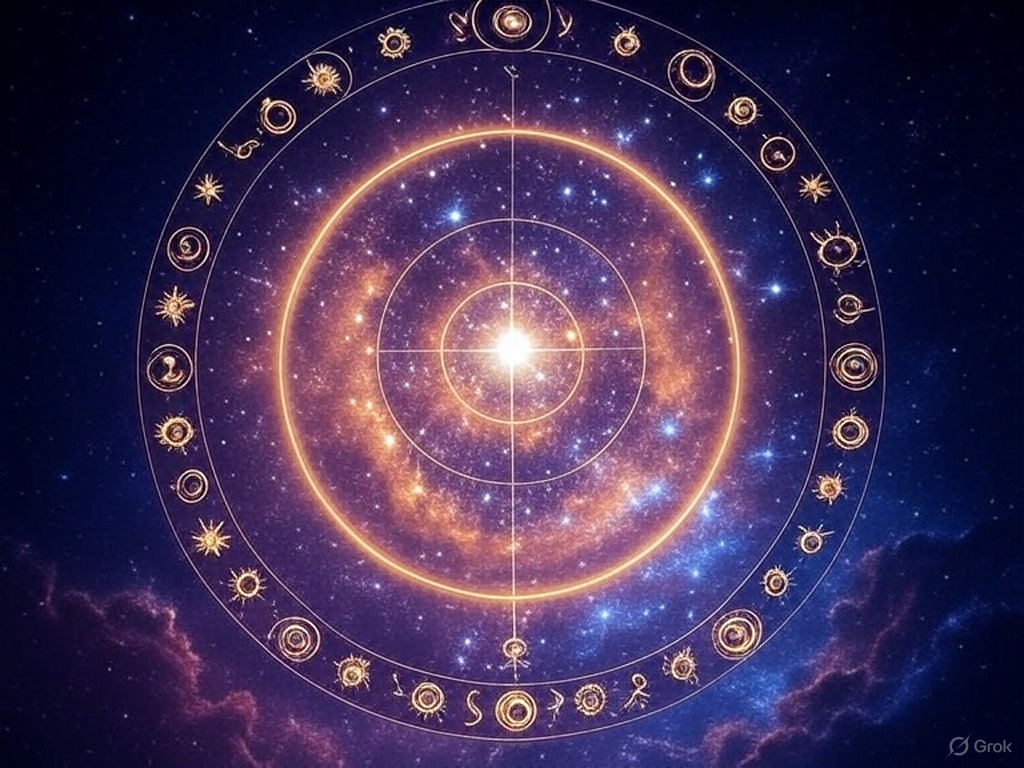
The legend of Soma being partial to the bright star Rohiṇī (Aldebaran) is retold in MS with some hitherto unknown information. This appears from (MS.86) onwards eventually laying the foundation for the development of a predictive methodology based on similarity of past occurrences as precursors for prognosis of future events, to guide humans on earth.
This approach was observational and based on anomalies in terms of the daivatyaṁ (divinity) or the devatā characterization of the nakṣatras. This theory forms the ideological as well as the spiritual basis for Vedic-Hindu astrology, a few salient points of the cosmic drama (MS.86 to MS.96) are summarised here.
Dakṣa Prajāpati had 27 (some say 28) daughters. He offered them to Soma to follow dharma, for which Soma agreed, but stayed exclusively with the radiant Rohiṇī. After the other daughters complained, Dakṣa summoned Soma for questioning. However, Chandramā (moon) said that he moves equally with all with no transgression. Prajāpati being not satisfied chided moon as a liar and cursed him to suffer from rājayakṣma.
Due to this Soma became weak and defeated. But then Soma understood the intention of Prajāpati, that henceforth ṛkṣāṇi (multiple stars) would become nakṣatram (single asterism). Since then that Soma moves in all the nakṣatra equally or uniformly, day and night.
The above narration means that Rohiṇī which was considered a single star associated with Prajāpati for astronomical purposes, was made into a nakṣatra consisting of five stars. Quite significantly, AVP an appendix for the Atharvaveda, takes Rohiṇī to be a single star (Table 1.2). It is implied here that in the distant past, moon was observed in night times with reference to some unequally spaced bright stars only. MS consistently discriminates tārā and nakṣatra. A major takeaway for history of observational astronomy and astrology in ancient India is from (MS.88) that declares - it is understood that stars become nakṣatra and henceforth moon moves equally in all the nakṣatras day and night. The equality cited here may notionally mean moon spends one ahorātra per nakṣatra, or that moon moves uniformly in the twenty-seven nakṣatra sector figures. But the issue of quantifying the equality is not that simple. After longer observations, (MS. 102, 106) mention the synchronization of the five-year solar cycle and the sixty-seven sidereal lunar cycle. This leads to the length of the sidereal month to be 27⅓ days.
MS.90: Dakṣa asks Soma to behave in the same way (samaṁ vartitavyaṁ) with the twenty-seven nakṣatras, so that activities such as fierce, quick, fixed, harsh, soft, moving, ordinary, can be portentously indicated. All karma (actions) on earth gets nucleated by conjunction of nakṣatra with Soma. Such a nakṣatra is the impulse (karmaṇya) for action on earth. All actions on earth including Vedic rites start when nakṣatra and Soma combine. Dakṣa says ‘for this purpose only my daughters were given to you.’
MS.91: Soma agrees, but wonders; ‘your daughters are all, by their attitude, equally disposed and I am Soma being saumya (calm/neutral). But the activities to be indicated are fierce, quick, fixed, harsh, soft, moving, ordinary! What should I do’?
In answer, Prajāpati asks Soma to stay in the nakṣatras by vikaraṇa-dharma (abnormal/unusual character). Once upon a time Soma combined with each of them by vikaraṇa, which is symbolized as the daivata of that particular nakṣatra. Such actions that are in synchrony with the daivata, succeed on earth also.
Two examples of this vikaraṇa are given for kṛttikā and rohiṇī. Soma had once stayed with kṛttikā in the form of agni (fire). So, when moon is conjugated with the nakṣatra kṛttikā, activities that may be classified as fiery; not just by direct fire or heat, but even by emotions and colour will succeed. Similarly, when moon is in rohiṇī, firm, fixed, (sthira) activities are indicated, because Soma as Prajāpati had firmly stayed in the past with rohiṇī.
This example points to the origin of the legend of Soma being excessively fond of star rohiṇī (one among the twenty-eight, before eighty-six stars made up the zodiac). The astronomical meaning of the legend is further discussed under (MS.88) in Chapter 3.
The guidance for humans under each nakṣatra is derived by matching the mundane activities with the quality and action of the corresponding daivataṁ or devatā. This is elaborated further in the Nakṣatrakarmaguṇa chapter of VGJ (vide Appendix A-2). This principle of having regent deities for the nakṣatras and its application is clarified as follows;
MS.95: This way, by whichever vikaraṇa viśeṣa (anomaly) Soma had stayed, that is the daivata of that nakṣatra. This is how, suitable times for various characteristic daivata related activities are decided. This is the advantage of stating the deities for the nakṣatras.
As per MS the practice of associating daivata with a nakṣatra is an ancient concept that comes from the remote past already formalized in the Ṛgveda. Soma is not just the visible moon, although moon is the representative of Soma in nakṣatra based interpretations. The Vedic Soma and Agni are deep, esoterically all-encompassing entities that cannot be accurately explained in linguistic terms. A crude analogy would be; if Soma is the male principle, Agni is the female principle in the universe. This is explained in an interesting way.
(contd. in next part)
Reconstructing Sāṃkhya-Yoga from the Mahabharata
Your help is Solicited
Embedded within the Mahābhārata is the oldest, undefiled Vedic science of Sāṃkhya and Yoga. I seek your support for this project in any way possible. Please consider donating any amount that you deem proper.
Support this project →My UPI ID is: 8296375300@ybl
No account needed · Every bit helps